Painted and henna-stained

… new-bathed, painted and henna-stained, and scented sweet. (Sa’di, 1258) Last week I saw a rare painting of a beautiful young woman painting her feet with henna. She has very lovely, multi-layered clothing, and is leaning against a splendidly orange cushion (with a graceful golden duck). The lady has her feet on a pile of …
See more

Muratowicz’ journey

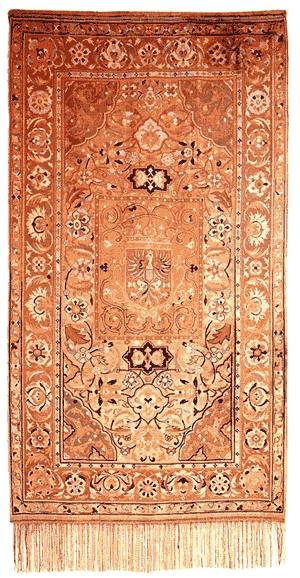
In 1601 Muratowicz, travelled  from Poland to Isfahan and back to buy, amongst other things, some carpets. Here’s a map showing what a long way it was: View muratowicz working.kmz in a larger map Muratowicz’ journey is not exactly the same as most European traders visiting Persia (he travels south of the Via Tartarica through …

See more

Woodworking

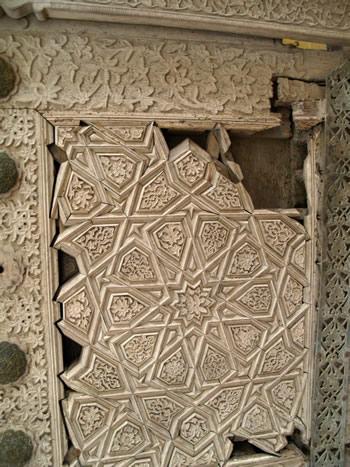
This piece in Edirne, in Western Turkey, is in poor condition, which allows the construction method to be seen: it is made from many relatively simple wooden pieces, slotted together, and then ‘framed’. [C.W.3]

Woodworking

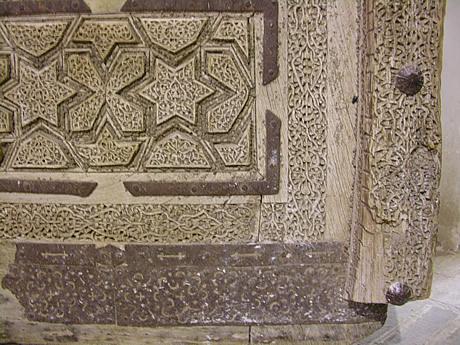
This very fine, interlaced wood carving – with some fancy metalwork, below – is undated, and not now in perfect condition. It was, however, made by a truly outstanding master craftsman, and is now in the same tomb in Torbat Heydarieh as the dated piece. [C.W.2]

Woodworking

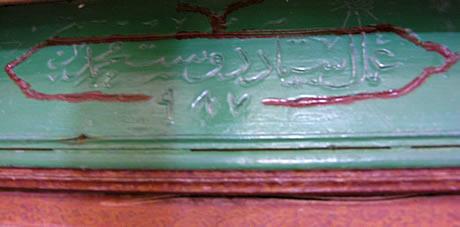
Wood does not often survive – but the wooden casing around this tomb in Torbat Heydarieh, in north-eastern Iran, is dated to AH987 – the equivalent of AD1579. [C.W.1]

Wall Painting

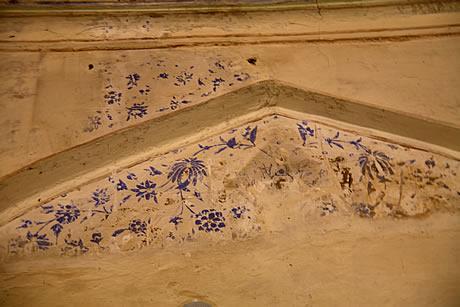
This (poor condition) wallpainting is Safavid-era, from the tomb of Shaikh Safi in Ardabil. The designs and raised application are quite different from the earlier examples of wallpainting. [C.P.8]

Wall Painting

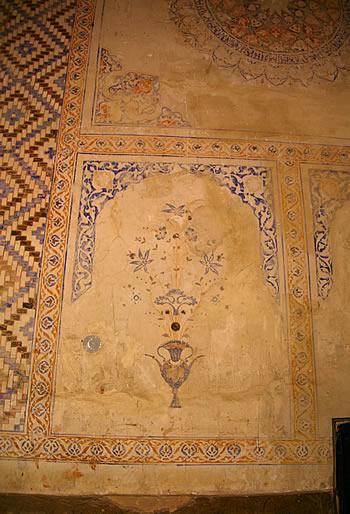
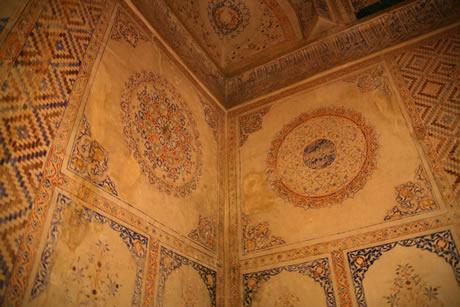
Since the blue-and-white porcelain arrived after the mid-fourteenth century, it may be that these designs in Torbat-e Jam actually derive from similarly-prestigious Chinese textiles. [C.P.7]

Wall Painting

Other motifs in Torbat-e Jam might be thought to evoke the highly sought-after Chinese blue-and-white porcelain. [C.P.6]

Wall Painting

These striking wallpaintings (probably from the first half of the fourteenth century) in Torbat-e Jam, NE Iran hint at the many cross-over influences from other media – here, perhaps, manuscript frontispieces and bookbindings. [C.P.5]