Muqarnas
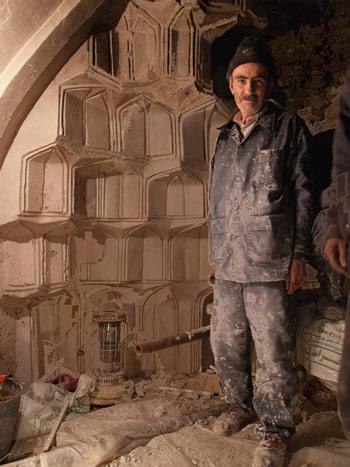
The ustad (master craftsman) shown here part the way up inside the high dome at Sarakhs, is standing in front of some partially-restored (and fairly basic) muqarnas. [C.M.3]
The ustad (master craftsman) shown here part the way up inside the high dome at Sarakhs, is standing in front of some partially-restored (and fairly basic) muqarnas. [C.M.3]
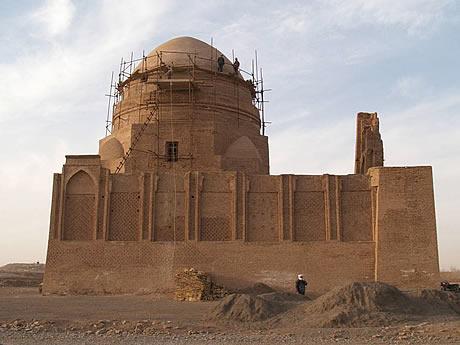
This is the Shaykh Luqman Mausoleum in Sarakhs, on the Turkmenistan-Iran border. It was built in 1356, and is now being restored. Getting access to themuqarnas (stalactite vaulting) right up in the top of the dome involved squeezing up between the double shelled walls of the lower part of the building; then an exposed and hair-raising …
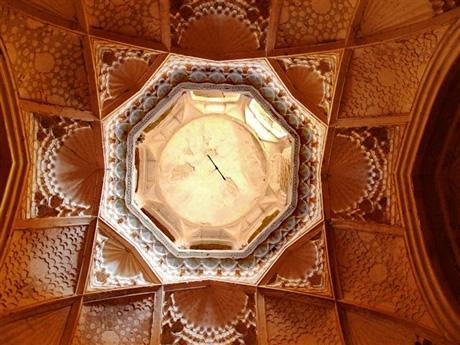
Muqarnas, sometimes called ‘stalactite vaulting’, are a three-dimensional form of architectural decoration of domes, niches and the underside of vaults. For the craftsmen-constructors, they require the application of detailed geometric principles; for the viewer, they allow infinitely imaginative reviewing. This Timurid muqarnas – from the Khargird madrese in NE Iran – has additional painted stucco …
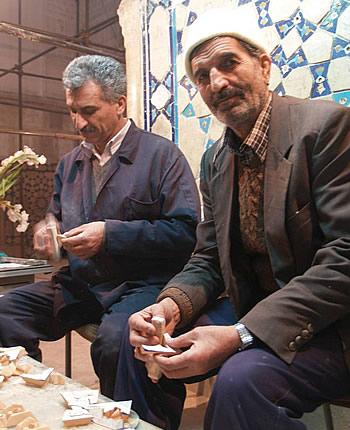
‘Cutting’ each precisely curved element to make up faience is painstaking work. These two men are ‘sanding’ individual pieces to make sure they are an exact fit. The building they are working on, in Taybad, in NE Iran, has soaring expanses of faience work that is slowly being restored. [C.T.5]
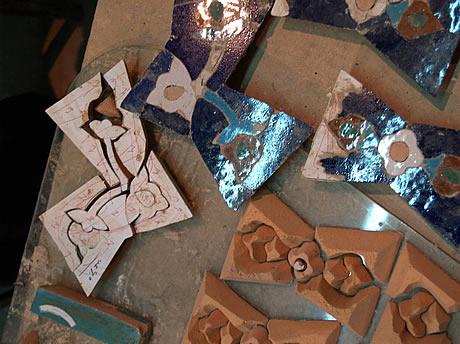
The small pieces making up the faience can be seen here: with the carefully drawn out paper guides stuck on tiles to left; the face-down pieces at bottom, waiting to be attached together; and the perfectly interlocking pieces at left (with some of the paper still to be removed). [C.T.4]
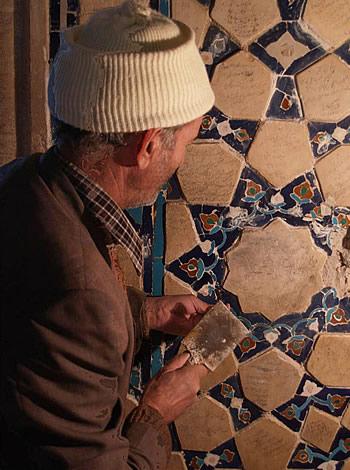
This ustad is part of the team restoring the faience tiles inset into this wall. He has to first remove the glazed tiles – without damaging any of the surrounding graffiti, since some of this is historically important in its own right. [C.T.3]
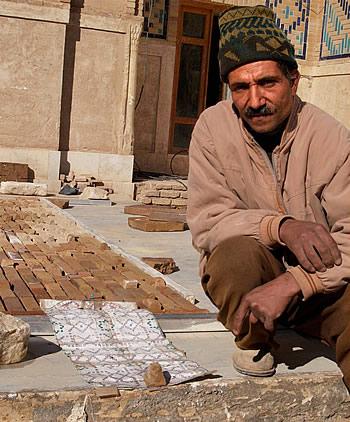
This ustad (master craftsman) is using a squared and scaled plan for the banna-i, very similar to those seen in some Mughal book paintings. [C.T.2]
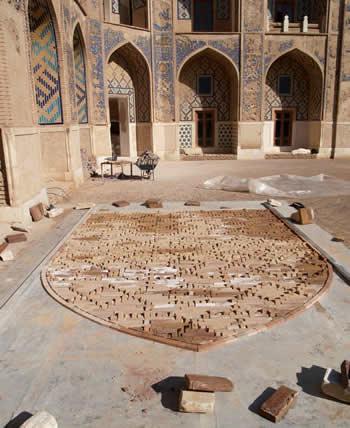
Many methods of ornamental tiling are traditionally used in Iran: includingbanna-i, faience, lustre, cuerda seca, as well as various monochrome and blue and white tiles. This image shows banna-i tiling, which uses alternating small glazed and plain tiles to make patterns or, top left, words. Banna-i tiling is constructed by laying the pieces of tile face down, as shown here. …
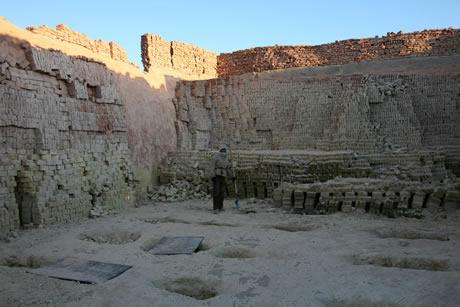
This kiln is now almost unpacked. The holes in the floor are where the heat of the flames ascends, and the especially hard-baked bricks from immediately above these are used for construction of water cisterns. [C.B.4]
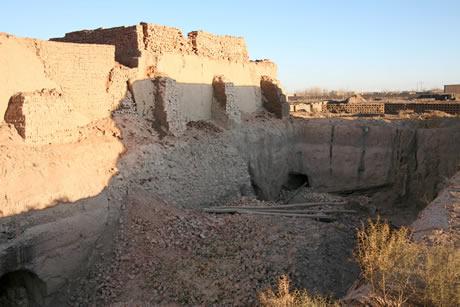
Traditionally the kilns were fired using camel-thorn growing on the nearby plains. Now oil is used – in the base of the pit several blackened openings under the kilns are visible (bottom left, plus two centrally at the corner of the pit), with some of the pipes used. Each firing takes around 72 hours. [C.B.3]